British Industrial Competitiveness Scheme (BICS): A Guide for UK Manufacturers. Could your manufacturing business benefit from BICS?
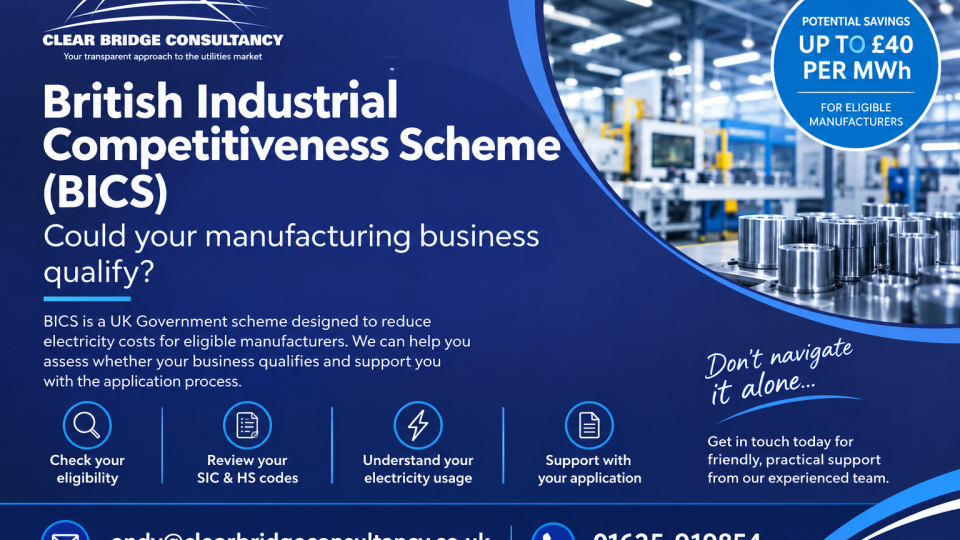
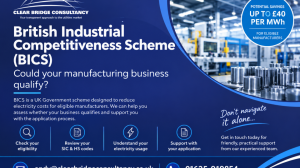
The British Industrial Competitiveness Scheme (BICS) is a UK Government scheme designed to reduce electricity costs for eligible manufacturing businesses in Great Britain.
For manufacturers facing increasingly challenging electricity costs, BICS could provide a significant reduction in the indirect policy costs included within electricity bills.
The scheme is expected to reduce electricity costs for eligible businesses by up to £40 per MWh, helping UK manufacturers remain competitive, protect margins and support future investment.
However, not every manufacturing business will automatically qualify. Eligibility depends on a number of factors, including your company's SIC code, the products you manufacture, the HS codes associated with those products and your electricity usage.
At Clear Bridge Consultancy, we can help manufacturers assess whether they are likely to qualify for BICS and, where appropriate, support them through the application process.
What is the British Industrial Competitiveness Scheme?
The British Industrial Competitiveness Scheme is a Government initiative aimed at helping eligible UK manufacturers reduce their electricity costs.
BICS provides eligible businesses with exemptions from certain indirect electricity costs, including:
- Renewables Obligation (RO)
- Feed-in Tariffs (FiT)
- Capacity Market (CM)
The exemptions are intended to reduce the cost of electricity for qualifying manufacturing sites and help improve the competitiveness of UK industry.
The Government estimates that the scheme could support more than 10,000 manufacturing businesses.
How much could a business save through BICS?
The potential saving will depend on the individual business and its electricity consumption.
The Government states that BICS could reduce electricity costs by up to £40 per MWh.
For a manufacturer consuming significant quantities of electricity, the potential financial benefit could therefore be substantial.
For example, a business consuming 2,000 MWh of electricity per year would be purchasing a significant volume of electricity against which BICS relief may potentially apply.
However, it is important not to assume that the headline saving will apply in full to every business. The level of support is determined as part of the BICS assessment and depends on the business, manufacturing activity, electricity consumption and other factors.
This is why assessing your individual circumstances is important.
Who can qualify for BICS?
There are several key eligibility requirements.
To qualify, a business must satisfy the Government's criteria, including:
1. The business must be registered with Companies House
The business must be appropriately registered with Companies House.
For limited companies, the relevant SIC code recorded at Companies House is an important part of the BICS eligibility assessment.
2. The business must operate within an eligible manufacturing sector
BICS is targeted at manufacturing businesses operating within eligible sectors.
The Government has published a specific list of eligible SIC 2007 codes.
Having a manufacturing-related SIC code does not automatically mean that a business qualifies. The particular SIC code needs to fall within the eligible list.
3. The business must manufacture eligible products
BICS eligibility is also linked to the products manufactured by the business.
The Government has published a list of eligible Harmonised System (HS) codes covering products that fall within the scope of the scheme.
This means that simply being a manufacturer is not necessarily enough. The products being manufactured need to be considered alongside the relevant SIC code.
4. The business must meet the electricity usage requirements
BICS also includes an electricity intensity requirement.
The assessment looks at the relationship between electricity use and the economic value generated by the business. This is designed to target support towards businesses where electricity costs have a significant impact on competitiveness.
For this reason, reviewing your electricity consumption and the information available for your manufacturing operations is an important part of determining whether BICS could benefit your business.
SIC codes and HS codes – why are they important?
One of the areas we believe manufacturers need to pay particular attention to is the difference between SIC codes and HS codes.
Your SIC code relates to the economic activity carried out by your company.
Your HS code relates to the products being manufactured.
Both are relevant to BICS.
A business could therefore be involved in manufacturing but still need to establish whether its specific manufacturing activity and products fall within the Government's eligible SIC and HS code lists.
This is one of the reasons we recommend that manufacturers do not simply assume that they qualify based on their industry or the fact that they have high electricity consumption.
BICS is assessed on a site-by-site basis
Another important point is that BICS operates on a manufacturing site basis.
If a business operates multiple manufacturing sites, each site needs to be considered as part of the assessment.
This can become particularly important where a company:
- operates more than one manufacturing location;
- has multiple electricity meters;
- manufactures different products at different sites;
- has shared meters;
- has both eligible and non-eligible manufacturing activity; or
- has complicated electricity supply arrangements.
Understanding exactly what electricity is being used for eligible manufacturing activity can therefore be an important part of the application.
When can businesses apply for BICS?
The first BICS application window opened on:
1 October 2026
The deadline for applications is:
30 November 2026 at 11:59pm
This is an important deadline for eligible manufacturers.
Businesses should not leave their application until the last minute, particularly where they need to gather electricity bills, product information, Companies House details or other supporting evidence.
Once an application has been submitted, it cannot simply be amended, so taking time to prepare the application and supporting information carefully is important.
What information is required for a BICS application?
The Government's guidance states that businesses may need to provide a range of information and supporting evidence.
This can include:
- Companies House information;
- company registration details;
- manufacturing site information;
- electricity meter information, including MPANs;
- electricity bills;
- electricity consumption information;
- details of the products manufactured;
- supporting evidence relating to eligible products;
- relevant SIC codes;
- relevant HS codes; and
- information relating to electricity used for eligible manufacturing activity.
The exact evidence required can vary depending on the circumstances of the business.
For example, additional considerations can arise where a site has shared meters, private electricity networks, third-party arrangements or produces both eligible and non-eligible products.
What are the BICS application deadlines?
For the first year of the scheme, the key dates are:
1 October 2026 – BICS applications open.
30 November 2026 at 11:59pm – BICS application deadline.
Early 2027 – Businesses are expected to receive confirmation of their eligibility decision.
April 2027 – Exemptions relating to the Renewables Obligation and Feed-in Tariffs are expected to begin.
October 2027 – Capacity Market exemptions are expected to begin.
These dates relate to the first year of the scheme.
How long does BICS support last?
Successful applicants can receive an exemption for five years, subject to the Government's ongoing requirements.
Businesses receiving BICS support will have continuing obligations, including an annual declaration and a more detailed review at year two.
It is therefore important to view BICS as more than simply a one-off application.
Businesses need to ensure that their circumstances continue to support the level of relief they receive.
How Clear Bridge Consultancy can help with BICS
Understanding whether your business qualifies for BICS can be complicated.
At Clear Bridge Consultancy, we can help manufacturers work through the eligibility requirements and establish whether it is worth progressing with an application.
Our support can include:
Reviewing your BICS eligibility
We can look at your business activities, SIC codes, manufacturing processes, products and electricity consumption to help establish whether your business is likely to fall within the scope of BICS.
Reviewing SIC and HS codes
We can help you understand the relevance of your SIC codes and HS codes and how they relate to your manufacturing activities and products.
Reviewing your electricity consumption
We can help you understand the electricity information required for the assessment and identify the relevant data needed to support your application.
Helping prepare your application
If your business appears to qualify, we can help you work through the information and supporting evidence required for the BICS application.
Helping you navigate the process
Rather than leaving you to work through the Government guidance alone, we can provide practical support throughout the process and help you understand what information is required.
Do not assume that you don't qualify
One of the biggest reasons we recommend manufacturers review BICS carefully is that eligibility isn't always obvious.
A business may describe itself as a manufacturer, but its SIC code or products may not fall within the eligible categories.
Equally, a manufacturer may initially assume that it does not qualify without looking closely at the specific products it manufactures, its electricity consumption and the relevant eligibility criteria.
If you are unsure, it is worth checking.
The Government has provided its own BICS eligibility checker, but the checker provides an initial indication rather than a final eligibility decision.
A more detailed review of your business, manufacturing activity, electricity consumption and supporting evidence can help you establish whether an application is worth pursuing.
Could your manufacturing business qualify for BICS?
If you operate a manufacturing business in Great Britain and your electricity costs are a significant part of your operating costs, BICS is something you should be looking at now.
The potential reduction in electricity costs could make a meaningful difference to businesses with significant electricity consumption.
At Clear Bridge Consultancy, we can help you assess your position and, if appropriate, support you with the BICS application.
You don't need to work through the eligibility criteria on your own.
Speak to Clear Bridge Consultancy about BICS
If you would like us to review whether your manufacturing business could qualify for the British Industrial Competitiveness Scheme, get in touch.
We can help you understand:
- whether your business appears to meet the BICS eligibility criteria;
- whether your SIC code is eligible;
- whether the products you manufacture fall within the relevant HS codes;
- how your electricity consumption may affect eligibility;
- what supporting information you may need; and
- what you need to do to progress with an application.
Contact Clear Bridge Consultancy today:
Email: andy@clearbridgeconsultancy.co.uk
Telephone: 01625 919854
We are happy to have an initial conversation and help you establish whether BICS is something your business should be pursuing.
Don't assume you won't qualify – let's take a look.